Why Embedded Designers Should Reconsider USB Flash Drives and SD Cards
Sep 04, 2026
Article
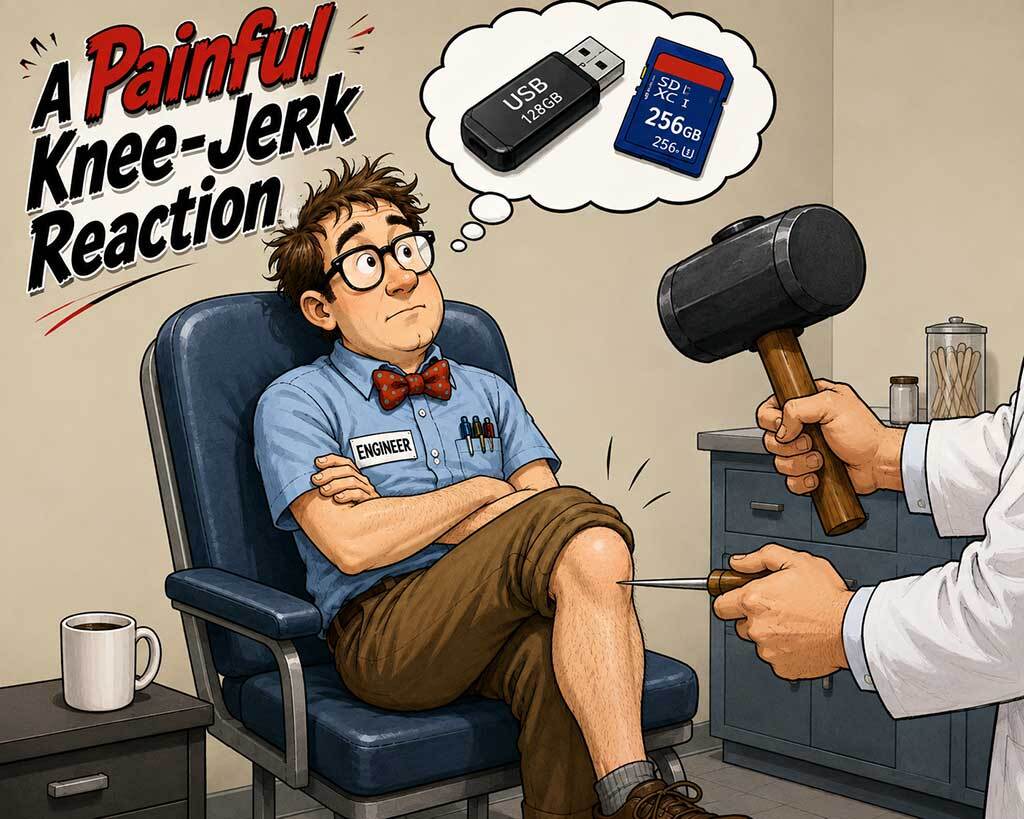
In the past, when an embedded design called for removable memory, the knee-jerk response was often, “We’ll use a USB flash drive,” or maybe, “We’ll use an SD card.” In many applications, however, the actual storage requirement is only a tiny fraction of the gigabytes provided by today’s flash drives and SD cards.
Today, that no-brainer decision is becoming much more expensive. A PCWorld comparison of these devices in April 2025 and April 2026 found substantial price increases across USB flash drives, SD cards and microSD cards, with a number of products more than doubling in price.1 For embedded designers, the increase in these prices is a good reason to ask the question, do you really need gigabytes of removable storage?
In this article, we’ll look at:
- What is driving the large increase in USB flash drive and SD card prices?
- When might the pricing improve?
- What alternatives should embedded designers consider?
What is Driving the Price Increase?
- AI and Data Centers Are Increasing Demand for NAND Flash
USB flash drives and SD cards use NAND flash memory. NAND is also the storage medium used in solid-state drives (SSDs), including the high-capacity enterprise SSDs deployed in AI infrastructure and large data centers. According to TrendForce, demand for NAND flash in 2026 continues to be driven primarily by AI inference and large-scale data-center deployments.2
- Manufacturers Are Prioritizing Higher-Value Products
The issue is not simply that every NAND device competes for an identical chip. The broader manufacturing economics matter. NAND suppliers are allocating more capacity to higher-value enterprise SSD and server products. At the same time, mature processes used for lower-capacity and legacy products are becoming less attractive. TrendForce reports that this capacity realignment is constraining supply for mature NAND products and the retail-storage market, including USB flash drives and SD cards.2
- Capacity Has Not Expanded Fast Enough to Match the Shift in Demand
The NAND market entered this cycle after the 2022–2023 oversupply period, when weak pricing led manufacturers to reduce production and investment. The subsequent surge in AI-related storage demand arrived while fab space remained constrained and suppliers were focusing on process-node migrations rather than adding significant new production capacity. The result has been an undersupplied market, elevated pricing and tighter availability for some products.3
How Much Have Removable Memory Prices Increased?
The table below shows the change in pricing for 64 GB flash-based products. The following examples come from PCWorld’s April 2026 comparison of retail prices with the same products one year earlier.1 The table also includes prices from August 2026.
| Product | Capacity | Apr. 2025 | Apr. 2026 | Aug. 2026 |
| USB Flash Drive (Type A Connector) | 64 GB | $13 | $23 | $29 |
| SD Card | 64 GB | $14 | $35 | $33 |
| MicroSD Card | 64 GB | $11 | $16 | $31 |
When Will Things Improve?
It is unclear when or if pricing for NAND flash-based products will return to levels that embedded designers have become accustomed to. TrendForce is forecasting NAND flash contract prices to rise another 10%–15% quarter over quarter in Q3 2026.2 That is a slower rate of increase than earlier in the year but indicates prices are still rising.
Looking further ahead, TrendForce expects NAND supply growth to begin outpacing demand in 2027, with current supply constraints easing in the second half of 2027.3 That does not guarantee a return to previous pricing levels, however. AI and server demand are expected to remain strong, and suppliers are continuing to prioritize higher-value products.
What Alternatives Memory Products Should Designers Consider?
When designing an embedded system and considering removable memory, the most important question is not, “What removable memory device should I use?” The first question to ask is, “How much data does my application actually need to store?”
When I have asked engineers that question in the past, it was not uncommon to hear, “Not very much at all. Four gigabytes would be plenty.” I would then ask, “But how much data will actually be written to that 4 GB device?” The answer might be, “A couple of megabytes.” In that case, the real requirement is closer to 2 MB than 4 GB.
The first question to ask is, “How much data does my application actually need to store?”
Right-sizing the storage requirement can open the door to non-NAND technologies that may offer a simpler and more stable architecture for low-capacity embedded applications. The table below shows which nonvolatile memory technologies are likely choices for various memory capacities.
Match the Memory Technology to the Capacity
| Capacity Need | Likely Approach (memory technology) | Design Consideration |
| > 8 GB | NAND flash | USB flash drives and SD cards are generally the practical options. |
| 256 MB - 8 GB | NAND flash, including legacy SLC NAND flash | Specialty USB flash drives and SD cards that utilize legacy SLC NAND flash exist, but availability and pricing can be a challenge. |
| 8 MB - 256 MB | Serial NOR flash, Serial NAND flash | Serial NOR flash is attractive at the lower capacities, but costs increase at the higher end. Serial NAND is lower cost, but the designer may need to manage the NAND. |
| ≤ 8 MB | EEPROM or Serial NOR flash (or FRAM/FeRAM or MRAM for special applications) | Strong opportunity to avoid NAND flash by leveraging EEPROM or Serial NOR flash. Some specialty applications may consider FRAM/FeRAM or MRAM. |
Greater Than 8 GB
If an embedded application truly requires more than 8 GB of removable storage, NAND flash is generally the practical choice. USB flash drives and SD cards provide the capacity, performance and ecosystem needed at this scale.
The tradeoff today is higher pricing, longer lead times for some products and continuing product transitions. Datakey has seen this firsthand with RUGGEDrive products as Kioxia transitions from BiCS3 to BiCS5 NAND. Older BiCS3 capacity options such as 16 GB and 32 GB are no longer available in the newer BiCS5 TLC generation, which begins at 64 GB.
256 MB to 8 GB
In this range, removable products are still predominantly NAND-based. Lower-capacity industrial SD and USB products often rely on mature NAND technologies such as SLC. Those technologies can be attractive for write-intensive or long-life applications, but mature NAND supply is currently tight and can carry a substantial price premium.
256 MB and Below
At these lower capacities, designers have the option of avoiding NAND flash altogether. EEPROM can be a good fit for smaller storage requirements, while serial NOR flash can extend well into the megabyte range with good affordability. These technologies can eliminate the need for a NAND controller to manage error correction, bad blocks, wear-leveling, etc., they use simple serial interfaces (like SPI and I2C) and provide storage capacities that more closely match what many embedded applications actually require.
The challenge is packaging these memory technologies in a rugged, removable format suitable for repeated use in an embedded system. EEPROM and serial NOR are normally sold as ICs, not as complete portable-memory devices with a mating receptacle. That is the problem Datakey Serial Memory products are designed to solve.
A Complete Removable-Memory System
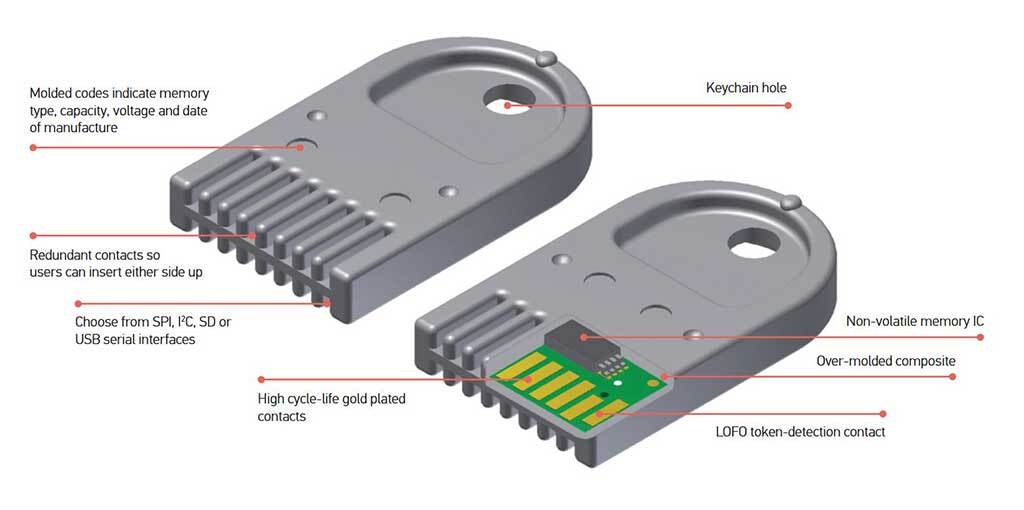
Datakey Serial Memory products use industry-standard nonvolatile-memory ICs, including EEPROM and NOR flash. The memory IC is mounted to a PCB, connected to a high-cycle-life contact system—often with redundant contacts—and solid over-molded into a rugged Datakey form factor. Datakey also offers mating receptacles, including board-mount and panel-mount options.
The result is more than an IC in a plastic enclosure: it is a complete embedded removable-memory system combining standard nonvolatile memory, a rugged portable form factor with durable contacts and a receptacle that is designed for high reliability.
For applications where a standard product does not meet the exact capacity, interface, mechanical or environmental requirements, Datakey also develops customized portable-memory solutions. Celebrating 50 years in business, Datakey has earned a reputation as a proven, trusted source for reliable portable-memory products used in long-life defense, medical, industrial, agricultural and commercial applications.
Conclusion
Before automatically specifying a USB flash drive or SD card for your next embedded design, determine how much data the application actually needs to store. If the answer is megabytes—or even kilobytes rather than gigabytes—a removable EEPROM or NOR flash solution may provide a simpler, more stable and potentially more economical alternative to NAND-based storage.
Today’s NAND price spike makes that design question more urgent, but the principle will remain valid even after the market eventually stabilizes: choose the memory technology and capacity that best fit the application rather than defaulting to the largest, most familiar removable format.
Datakey offers rugged removable-memory solutions using EEPROM and NOR flash technologies for embedded applications.Contact us to discuss your capacity, interface and environmental requirements.
Paul Plitzuweit
Sr. Product Manager, Datakey
ATEK Access Technologies, LLC
Sources
1PCWorld, “Investigation: Even USB flash drives and SD cards are becoming unaffordable,” Apr. 14, 2026.
2TrendForce, “AI Server Demand Continues to Support Memory Prices in 3Q26…,” July 3, 2026.
3TrendForce, “NAND Flash Supply Growth to Outpace Demand in 2027…,” July 21, 2026.